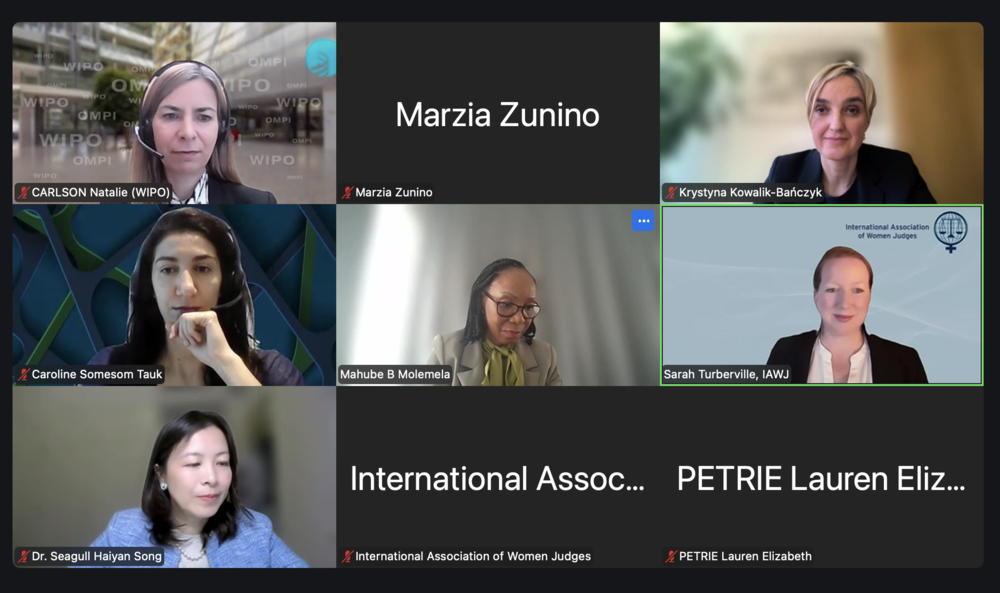
 On the occasion of World Intellectual Property Day 2026, the International Association of Women Judges (IAWJ) and the World Intellectual Property Organization (WIPO) convened a global webinar examining the evolving relationship between intellectual property law and the sports industry. Bringing together more than 200 attendees from across jurisdictions, the discussion offered a rich comparative perspective on how courts are shaping the legal frameworks that underpin modern sport—from broadcasting and branding to technological innovation.
Opening the event, IAWJ Executive Director Sarah Turberville situated the conversation within a broader cultural and economic shift. As women’s sports gain long-overdue visibility and investment, she noted, the legal structures governing the industry are becoming increasingly significant. The rise in popularity has been accompanied by growing demands for equal treatment, making it timely to examine how intellectual property rights function in this space. At the same time, she emphasized the broader mission of the IAWJ, highlighting the organization’s global network of over 6,500 women judges and its commitment to strengthening the rule of law through judicial leadership, collaboration, and knowledge exchange.
Natalie Carlson of WIPO followed by framing the discussion within the organization’s mandate as a United Nations agency dedicated to fostering innovation and creativity through effective intellectual property systems. She introduced this year’s World IP Day theme, “IP and Sports: Ready, Set, Innovate,” and underscored the central role of courts in interpreting and applying IP law in ways that shape how sports are produced, consumed, and commercialized around the world.
The first panelist, Judge Mahube Molemela of South Africa’s Supreme Court of Appeal, examined the question of copyright protection in sports broadcasting. Her presentation centered on a landmark case involving Tellytrack, a company that produced and transmitted horse racing broadcasts, and a group of bookmakers who displayed those broadcasts to customers without authorization. The dispute raised a fundamental legal question: while a live sporting event itself is not considered a copyrightable work due to the absence of a defined author, could the broadcast of that event qualify for protection?
The court ultimately answered in the affirmative, recognizing that sports broadcasts are far more than passive recordings. Judge Molemela explained that the production process involves significant creative and technical input, including camera direction, editing, graphics, and commentary. Even the brief delay between recording and transmission was sufficient to meet the legal requirement of fixation, as the broadcast was captured and processed before reaching viewers. By acknowledging the layered production behind what might otherwise appear as a straightforward transmission, the court affirmed that such broadcasts constitute protected audiovisual works. The decision marked an important recognition of the investment and creativity involved in sports media production, while also reinforcing the rights of content creators against unauthorized commercial use.
The discussion then turned to second panelist, trademark law in the European Union, Judge Krystyna Kowalik-Banczyk offering insight into a case concerning the attempted registration of the mark “Tour de X” and its potential overlap with the well-known “Tour de France.” The dispute required the court to assess whether the similarity between the two marks was likely to confuse consumers or improperly benefit from the established reputation of the earlier trademark.
At the heart of the court’s reasoning was the concept of distinctiveness. While “Tour de France” undoubtedly enjoys global recognition, the court found that the shared element “Tour de” is not inherently distinctive but rather descriptive of cycling competitions more generally. As a result, its presence in both marks did not create a sufficient likelihood of confusion. The court also rejected the argument that the newer mark would unfairly exploit the reputation of the established one, concluding that the connection between the two was too weak to constitute reputational harm. The decision reflects a careful balancing act within trademark law: protecting well-known brands without granting them overly broad control over common or descriptive language.
Third panelist, Judge Caroline Somesom Tauk of Brazil explored the complexities of patent law through a series of cases involving a seemingly simple but widely used innovation: a spray employed in football matches to mark distances during free kicks. The dispute, which involved the Brazilian company holding the patent and the international governing body FIFA, highlighted one of the most fundamental principles of patent law—the territorial nature of rights.
Despite the global reach of professional sports, patent protection remains strictly national. Judge Tauk explained that even though the patent holder had secured rights in dozens of countries, enforcement could only occur within each individual jurisdiction. This meant that legal action had to be pursued separately in every country where infringement was alleged. The Brazilian courts initially found in favor of the patent holder, pointing to evidence of bad faith in negotiations and unauthorized use of the technology. However, ongoing procedural developments have left the case unresolved, illustrating both the complexity and the fragmentation of patent enforcement in a globalized industry. The case serves as a powerful reminder that while sports operate across borders, the legal frameworks governing innovation remain rooted in national systems.
The final segment of the webinar, led by moderator Dr. Seagull Haiyan Song, shifted the focus toward the future, examining how artificial intelligence is transforming the sports landscape and raising new intellectual property challenges. Over the past few years, AI has rapidly expanded its role in areas such as performance analysis, fan engagement, and content creation. Teams and organizations are increasingly relying on advanced data analytics to refine strategies, optimize training, and enhance the spectator experience.
Yet these technological advances are accompanied by significant legal uncertainties. Dr. Song highlighted emerging disputes involving the use of copyrighted material to train AI systems, as well as concerns about the unauthorized use of athletes’ images and likenesses in AI-generated content. Such practices raise complex questions about ownership, consent, and economic rights, particularly in a field where endorsement deals and personal branding are central to athletes’ livelihoods. The tension between innovation and regulation is becoming increasingly pronounced, requiring courts to grapple with issues that were largely unimaginable just a few years ago.
Taken together, the discussions throughout the webinar revealed a common thread: intellectual property law is both a driver of innovation and a mechanism for balancing competing interests in a rapidly evolving industry. Whether addressing the creative labor behind sports broadcasts, the boundaries of brand protection, the territorial limits of patents, or the disruptive potential of artificial intelligence, courts play a crucial role in shaping how sports are experienced and commercialized worldwide.